

Yohji Yamamoto’s Fall/Winter 2021 menswear collection arrived as a digital presentation, filmed at the Aoyama flagship in Tokyo. Accompanied by the designer’s own voice and compositions, it framed itself as “a statement about today’s world,” but the message was layered with ambiguity. Words were present, printed, embroidered, and scrawled across garments, but the phrases, from “Amazing Grace” to “Born a Terrorist,” lacked narrative cohesion. They registered more as noise than critique, disrupting rather than deepening the collection’s tone.
Where the clothing moved beyond text, it regained clarity. Yamamoto’s strengths lie not in declarative statements but in silhouette and structure. Draped trousers with exaggerated proportions recalled Chaplin’s poetic physicality. Sculptural greatcoats curved around the body with theatrical weight. These were not just garments but postures, ways of standing in the world. Armor-like outerwear, mesh gloves, and muzzle-like masks introduced a medieval strain, colliding with the familiar iconography of the Yamamoto punk, anarchic, black-clad, heavy with subtext.
Yet if these figures carried rebellion, it was no longer feral. They read as vulnerable. Oversized, layered, and often corseted, the models moved with restraint rather than aggression. The corsetry details, rows of hook-and-eye fastenings on tailored pieces, tempered the theatrical with control. One coat, stiff as neoprene, reflected a faint shimmer under the lights, echoing night sky rather than streetlight. Rose-petal motifs on shirts and fluid pants offered moments of softness without surrendering structure.
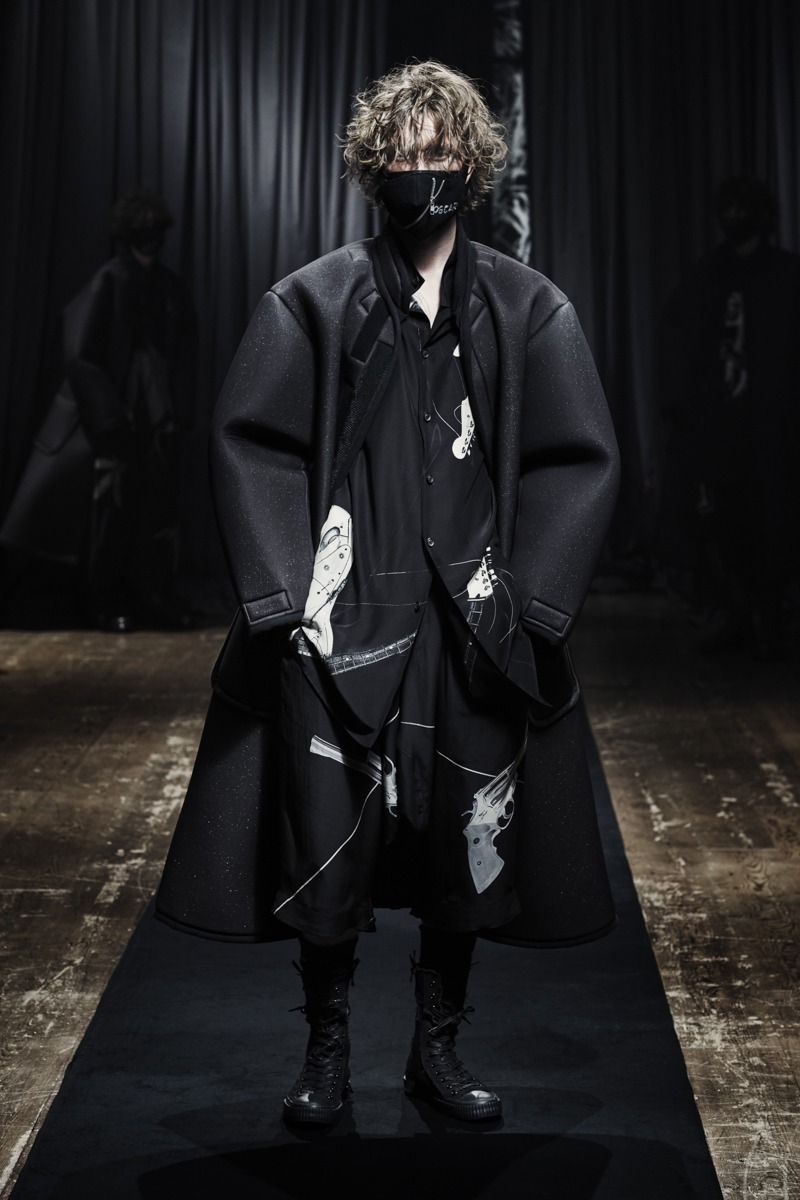
In the show’s edited format, practical interruptions such as style codes and fabric composition broke the visual rhythm. But they also exposed the blend of natural and synthetic fibers, a nod to Yamamoto’s 1990s Homme collections. This gesture toward his own archive did not feel nostalgic. Instead, it reflected the temporal dislocation running through the show. The collection may be grounded in present-day observation, but its internal logic remains outside of time.
Yamamoto is not a designer who adapts to the era. He filters it. The gestures in this collection, corsetry, draping, armor, slogans, are all long-standing elements in his vocabulary. What changes is their charge. As fragments of identity and masculinity are being renegotiated across cultures, Yamamoto’s men are less militant than they are in flux. Their defiance is not directed outward but channeled into form.
There is no moral or closing argument here. Yamamoto does not resolve the contradictions he lays out. Instead, he offers presence. His best work in this collection reminds us that fashion can hold tension without collapse, that clarity is sometimes found not in slogans but in structure. The world shifts. Yamamoto, as always, listens before he speaks.
Photographed, filmed and directed by TAKAY
Hair by Takuya Takagi
Make-up by Yuka Hirac
Music by Jiro Amimoto
www.yohjiyamamoto.co.jp
@yohjiyamamotoofficial
Highlights from the Collection


Photos courtesy of Yohji Yamamoto by TAKAY