

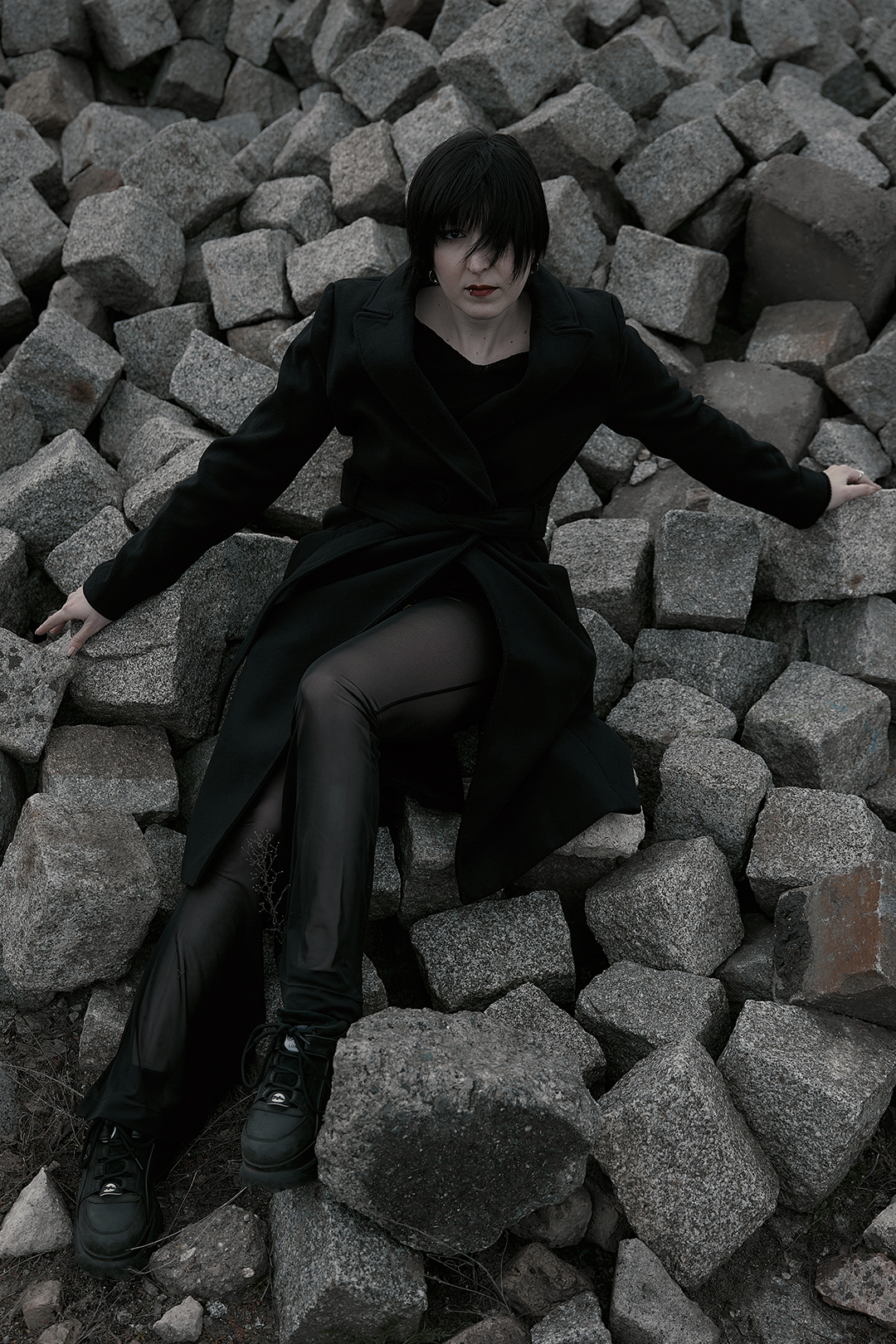
Avilynn is a Berlin-based sound artist, DJ, and label curator who moves between experimental sound design and techno with a fluidity that defies convention. Her immersive sets and multidisciplinary practice leave a distinct imprint, the result of a career that has unfolded under multiple aliases and consistently reshapes the boundaries of electronic music.
In 2020, she founded Taisha Records, debuting as Avilynn with an EP that found an audience in Berlin, London, Italy, Tokyo, and Australia. Her most recent work, released on Answer Code Request Records, signals an evolving trajectory that also extends into her collaborative project, Not On Label (NOL), a platform devoted to championing overlooked artists and fostering an inclusive vision of club culture rooted in techno’s heritage.
Her music has appeared on the Boiler Room Podcast and NTS Radio, while her performances have brought her to Astron, Tresor, OXI, and Watergate. Beyond the booth, she continues to explore new creative avenues, from designing limited-edition modular cases to rethinking the infrastructure that supports the scene.
Iconia: Your sound navigates between experimental sound design and techno yet avoids the constraints of either. How do you approach building a set or a track without succumbing to genre expectations?
Avilynn: I approach every track as a new canvas in a playful, childish way. I think that the constraints are set by ourselves. It’s easier to release music if you follow genre expectations, but your work will not stand out as much. There are many great artists, though, who have managed to push genres’ boundaries and still meet expectations. I guess this comes from a fine line between the freedom of experimentation and following ‘unwritten rules’.
Taisha Records launched in 2020 as both a personal and curatorial platform. How has the label evolved since its inception and what gaps in the electronic scene were you aiming to address when founding it?
I founded Taisha Records mostly to self-release my discography. I had also used previous aliases before Avilynn, and I released a lot on other artists’ labels, but I wanted to be able to release my music without being dependent on others. Now, I want to release music on other artists’ labels as well, but at that time, it was better for me to curate the whole project. My debut EP got international appeal even though it was not heavily promoted, and most said there was no market for it. My last one is my favorite (named 6), but it didn’t have the response I expected, even though I personally considered it one of my best works in the electronica realm.
My label then expanded to support other artists too, with a great example being Dubplanet X, who was literally preparing a podcast while his home was bombarded, and he did a great job. I used to catalog records at Recordsale, and many people asked who did this podcast when I let it play at work.
Now, the label is temporarily or permanently closed. I may return to release my unreleased ambient album, which I produced within a month at 6AM back in 2019, but apart from that, I have no idea if I will continue releasing there or not.
The name Not On Label (NOL) suggests a rejection of industry gatekeeping. Can you speak about the ethos behind the project and how it redefines what collectivity and community can look like in club culture?
The name comes from the idea that it’s not just a typical label, but a community. It was always an effort to connect with other artists and highlight those who are often underrated. It was also about prioritizing music over everything else. My goal was to create something that could unite artists from all over the world, regardless of their status, ethnicity, sexual orientation, or any other background. While this may seem obvious, the reality is that the music industry can sometimes be divided, and I wanted to offer a space where artists could share their work without barriers. Many great artists don’t always have the social media skills or the platform they need to be seen, but that shouldn’t stop them from getting the recognition they deserve.
Not On Label may take a step back from releasing music after the next release with Deepneue, as it has been a lot of work, and managing a global project has its challenges. It’s a bit tricky to create opportunities for artists from different locations without the support of funding, but this has been an incredibly rewarding journey. That said, I’m excited about the possibility of starting an event series under the same name in the future. But nothing is sure yet!
Your music has gained traction across vastly different scenes in multiple countries. What do you think resonates universally about your work, despite geographic or cultural differences?
My work as a DJ got really recognized when I started playing more for people and less for myself. I still play what I like, but when I started having gigs again, I was rather disappointed, so I began doing it more for my friends and the clubbers rather than for myself. This shift had a huge impact on how people resonated with my sets.
Techno is also a genre that unites a diverse group of people, but I think another reason why people resonate with my work is that I bring 12 years of experience. Some people have followed my work for over a decade, across three different aliases. Even though I keep my previous alias low-key, when I played at Astron after around 7 years of not performing in Athens, some people who already knew me but didn’t recognize me gave really good feedback online about my set.
This means I received positive feedback regardless of whether people knew who I was or not, which made it feel more genuine. I somehow feel my dedication reflects when I am playing; I really enjoy it.
Lastly, I connect with clubbers on a deeper level. Many times, I invite them into my process or openly ask for their feedback on various topics. So, I guess it’s a mixture of selflessness, experience, and aura.
Your music has been described as avant-garde and forward-thinking by some music journalists. How do you respond to that kind of language, and do you feel any tension between recognition and staying rooted in the underground?
I think the support from journalists has been quite welcome, especially since my work was chosen based on the music, without any financial compensation. Nowadays, the industry is so competitive that even peers who like your work may avoid helping you. However, journalists are more likely to give positive feedback or promote your work if they genuinely like it. For example, I’ve received great support from artists in other fields, probably because they don’t see me as a threat. I’ve collaborated with visual artists, sound designers, and soon, dancers as well.
I don’t think recognition makes you commercial. If you stay true to your values, you can still be underground. Otherwise, it feels like punishing artists for creating great art, music, or sets. If you’re dedicated, your work will eventually be recognized, by a small group of people, or sometimes even a larger one. So, I don’t think recognition makes you less underground, but rather, it’s what you do with it that matters.
To be honest, I don’t really care about recognition. I know my value as an artist. For me, it’s more important to provide a quality set and a great experience for those who attend, to play more often and to work with promoters and clubs that respect the sacrifices I’ve made and the effort I’ve put in.
I wanted to offer a space where artists could share their work without barriers.”
You’ve performed at iconic Berlin venues like Tresor and Watergate. In your experience how are these spaces evolving or resisting change as techno continues to globalize and digitalize?
Unfortunately, Watergate is now closed, and I was lucky enough to play there before it closed. I also wanted to play at DeSchool but arrived a bit too late. Tresor, on the other hand, has been around for 33 years and has managed to survive through thick and thin, though I don’t know much about how they approach the rapid changes in the scene and surely it was a great experience playing there.
If I could comment on the overall situation, rather than on a specific club, I’d say that in the past, many pioneers found space in clubs. As Brian Eno once said, he believes in the concept of ‘scenius’ rather than ‘genius’. Clubs were platforms for great artists and pioneers to evolve. I’m not so sure this is happening anymore, as I personally struggle to find space despite my efforts and the constant positive feedback for my work. Maybe it’s me? Who knows.
Right now, the industry seems more focused on what appears to be successful, rather than investing in the long-term success of artists, which may seem more profitable, but is it really in the end? I’m not sure. Artists today have less and less time in the spotlight, and the lack of community support doesn’t help sustain the club scene. On the other hand, artists like me with a strong foundation are often forced to give up, as life gets more expensive, we face the challenges of juggling multiple professions while trying to focus fully on music and the consequences that constant exclusion could cause in our mental health.
One club that I believe makes a great effort when it comes to curation is Astron. This comes with a lot of financial risk, especially in a place like Athens, but I think it will pay off in the long run. It’s also remarkable what the Georgian scene is doing. Despite the big challenges in keeping the scene alive there, I think they make a genuine effort to sustain it.
Beyond audio your design work like your modular cases suggests a fluidity between mediums. How important is physicality and design in your broader artistic practice?
I like to be transparent about my contributions. The modular cases were created with the help of a designer, but I still curated the project and handled the handmade aspects, like sanding, painting, and providing guidance on ergonomics and the artists’ preferences. I blend curation and concepts with my music rather than focusing solely on design. Sometimes I also do design work, but my main focus is on concepts and curation.
Not all my work is conceptual, but most of it is, and it’s an important part of my practice because I tend to have a vision of how things could be, or I’m influenced by life in general. This is also why I’m selective, as much as possible, about the events I participate in or the artists I collaborate with. It’s not about arrogance; I just believe that curation is an art form. I think curating great events is a way of showing appreciation to the people who attend.
Curation doesn’t necessarily mean luxurious production. For example, commercial events may spend much more on production, but for me, they may still feel off, often focusing on those who will broadcast the experience rather than truly live it. Of course, investment in the sound system is important, and it should be a priority.
As for my own curative process, I used to guide graphic designers for an entire month on the artwork for my record releases. I always took my time and invested in every detail rather than just rushing to release something. I would spend time testing the sound, finding the right cutting engineer, selecting the best factories and making sure it was something that an audiophile could appreciate.
What’s next for you both musically and beyond and how do you imagine the future of electronic music outside the mainstream narrative?
If I find the right agent, I’ll organize my first tour! After four releases and so much interest from people, I think it’s about time. I want to collaborate with promoters who are interested in building steady, long-term relationships, and I’ll prioritize those connections. Ideally, I’d love to have a club residency in Europe or Georgia. I’m also working on finishing a few demos and some VAs. Depending on the number of gigs I get, I may also start doing live sets in the near future. Currently, I don’t have the necessary setup. I aim to do a DAWless live performance.
It’s hard to predict the future of the music industry, but I believe if it continues to function like a supermarket, it won’t be sustainable in the long run. It’s like trying to reverse-engineer great art. People like Alexander McQueen, or anyone who’s made a significant impact in their field, were dedicated to their craft. We can’t expect people who haven’t put in that level of work to create a lasting impact, it’s simply not possible.
Photos & Videos: Courtesy of Avilyyn
Video camera: @kantatach_studio